Showing posts with label evolution. Show all posts

Tuesday, April 23, 2013

Deforestation


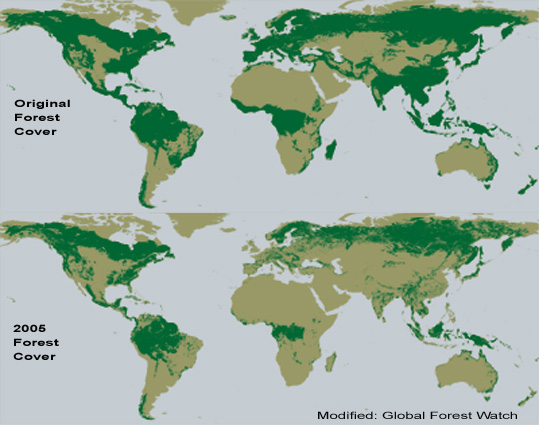
Deforestationhas been dramatically altering the Earth for years.  It is one of the leading causes of global climate change and it is drastically changing the natural course of evolution or all organisms.  Humans have all taken part, both directly and indirectly, in destroying forests all over the world. We use the wood from the trees for fuel and building materials and the cleared land can then be used for either agricultural or business purposes, such as constructing unneeded strip malls on all major roads.  Because of deforestation, hundreds on species of plants and animals have either become extinct or critically endangered.  The animals and plants that have neither become extinct nor endangered have been adapted to suit their new lives in there new habitat.  Without the trees and other plants of the forest, the Earth is slowly becoming depleted of much needed oxygen.
                There was once a bird in the family of parrots, the Carolina Parakeet that was native to the eastern coast of the United States, including New Jersey.  It became extinct in 1918 due to the mass deforestation to make room for farms for the new European immigrants.  Because of the loss of their forest habitat, the parakeets turned to eating the crops of farmers, who thought of them as pests and killed them, finishing off the last of the Carolina Parakeet.  

Monday, March 18, 2013

Hind Feathers and Flight of Early Birds


It is an extremely unknown fact that many dinosaurs and other reptiles possessed feathers to regulate their body temperature because they were all cold-blooded.  However, recent discoveries show that early birds had large legs similar to an ostrich, but their legs did not have tiny feathers, rather they were covered in long feathers that appeared to have been used for flight.  “A bizzare hind wing formed by a large pennaceous feathers (feathers with stiff vanes) along with the metasaurs is known in several non-avian dinosaurs and may have played an important role in the evolution of flight on the line to birds" (Zheng). 


Fossils of early birds with strange feathered hindlimbs were discovered and point to the fact that early birds may have had a similar body structure to a biplane, an airplane with two sets of wings, and upper and a lower.  Then, as evolution proceeded, the hindlimbs of birds shrank and lost their feathers.  And their forelimbs grew larder and grew longer and more efficient feathers.  Now the only feathers on the hindlimbs of modern birds are tiny and fluffy and used only for insulation purposes.  

The use of hindlimbs during flight was most likely much easier to accomplish than flying like today's birds.  Without the use of their hindlimbs, it it likely that birds never would have been able to leave the ground.  
            

Origin of Venom

             Venom is a widely used trait among the animal kingdom.  It has gone through convergent evolution throughout the animal kingdom.  Convergent evolution is when the same trait evolves for the same reasons, but in completely different lineages.
             Many animals use venom either to hunt or to protect themselves from predators.  "Venom is the mark of a special club, a select subset of the animal kingdom. It includes vipers, jellyfish, spiders, scorpions, centipedes, bees, cone snails, newts, platypus, and even a primate" (Zimmer).  Venom is made up of molecules specifically designed to harm another animal.  There are two types of venom, neurotoxins and  hemotoxins.  A neurotoxin is designed to break down the nervous system and the brain, causing a swift death in many animals.  A hemotoxin is designed to break down blood cells and organs, causing a slow and painful death.

 
            All the animals containing venom evolved this unique trait completely separate, but only for two main reasons.  They all evolved venom to either hunt prey or defend from predators.  Snakes, scorpions, and spiders developed venom to both hunt and defend themselves.  The black widow spider has one of the most potent venoms in the animal kingdom, but it cannot inject larger animals (such as humans) with enough venom to cause immediate fatality.  Many other animals like poison dart frogs, puffer-fish, and even some mammals developed venom to protect themselves from predators.  The poison dart frog has a unique, bright colored pattern to warn predators that its skin is highly toxic.
            Venom is a highly unique trait, but it is extremely advantageous to many different animals all throughout the animal kingdom. 

http://phenomena.nationalgeographic.com/2013/01/09/on-the-origin-of-venom/

Tuesday, February 12, 2013

How Did The Dinosaurs Evolve?

     Dinosaurs are one of the most famous groups of living organism ever to inhabit the Earth, but an interesting question is, where did they come from?
     Dinosaurs arose from a family of prehistoric reptiles called the archosaurs, who evolved from a common ancestor between fish and reptiles, one of the first creatures to make the transition from water to land.  From that common ancestor, three branches formed, the pelycosaurs, the therapsids, and the archosaurs.  The therapsids gave rise to the first mammals, who existed somewhat in secrecy along with the dinosaurs, but were unable to flourish with them.
     The archosaurs rose up after the Permian/Triassic Extinction Event, which was a massive extinction that wiped out three quarters of the world's terrestrial animals. The archosaurs, who thrived for thousands of years evolved and gave rise to the dinosaurs, who thrived for millions of years.
     The dinosaurs 'ruled' the Earth for an extremely long time, up until the K/T Extinction , that wiped out 70% of Earth's land animals, including the dinosaurs.  The most accepted theory behind this extinction is that a massive meteorite struck the Earth, clouding the sky for years killing many plants and many animals.  Without any plants, the herbivores starved and died out, and without herbivores, the carnivores had nothing to eat and also died out.  Also, the impact caused earthquakes and volcanic eruptions, destroying much of Earth as it was known 65 million years ago.
     Very few animals survived, but the ones that did consisted of some avian-like dinosaurs, that gave rise to birds, many mammals, and tortoises. With the extinction of dinosaurs, animals such as mammals were able to rise and evolve.

http://dinosaurs.about.com/od/dinosaurevolution/a/dinevolution.htm